
Is your website keeping up with Google’s latest changes? Because February 2026 introduced several important updates that are gradually changing how your content is crawled, discovered, and understood by Google.
while some of these changes might not seem obvious immediately, they can quietly influence how your website performs in search. So if you’ve noticed shifts in traffic or visibility lately, these updates could be part of the reason.
If you’re working on SEO, understanding these changes is essential. Here are the top highlights from Google’s February 2026 SEO updates:
- Google Updates HTML Crawling Limits for Improved Indexing Efficiency
- Google Rolls Out February 2026 Discover Core Update with Focus on Local Content
- Multi-Party Approval System was Introduced in Google Ads to Strengthen Security
- WebMCP Protocol Proposed jointly by Google and Microsoft to Make Websites AI-Agent Ready
- Google Improves Link Visibility in AI Overviews and AI Mode
- AI-Powered Configuration Now Available in Search Console
- Listicle Content Sees Sharp Decline in Google Rankings
Let’s take a closer look at these updates in detail below.
Google Updates HTML Crawling Limit
A major update was observed in Google’s documentation about how it handles HTML files during the crawling process. Google has clarified that it will now only process the first 2 MB of an HTML file during crawling and indexing.
Any content beyond this limit will simply be ignored by Googlebot. Googlebot stops fetching further content and indexes only the portion already downloaded.
There’s no need to panic. It’s important to understand that 2 MB is actually a very large size for a single HTML page. In practical terms, it can hold around 2 million English characters, which is more than enough for most websites.
The file size limit applies to the uncompressed version of the data, not the compressed size used during transfer. Once the uncompressed HTML size exceeds 2 MB, any additional content is not considered for indexing.
Google Discover Core Update
The Google Discover Core Update was rolled out on February 5, 2026, and completed on February 27, 2026. It introduced a major change to the Google discover system that decides which content shows up in Google Discover.
The objective of this update is to make the Discover experience more useful, relevant, and valuable for users.
Today, we're announcing an algorithmic change that enhances the quality of articles that appear on Discover. We're calling this the February 2026 Discover Core update.
— Google Search Central (@googlesearchc) February 5, 2026
Find out more in our blog post at https://t.co/AqLkmqcoPG
As Google specified in its official documentation:
This update will improve the experience in a few key ways:
- Showing users more locally relevant content from websites based in their country
- Reducing sensational content and clickbait in Discover
- Showing more in-depth, original, and timely content from websites with expertise in a given area, based on our systems’ understanding of a site’s content
Let’s understand these key changes in detail.
Prioritizing Locally Relevant Content:
Google Discover will now show more content from websites based in your own country. This means users are more likely to see local websites in their discover feed.
For example, if you are in the United States, you will see more U.S.-based content instead of mostly international sites. This update benefits local publishers and regional websites by giving them better visibility in Google Discover.
Removing Clickbait:
Google is now limiting the reach of exaggerated and misleading content in Discover. Instead, it is giving more visibility to content that is clear, useful, and genuinely informative. Websites that depend on clickbait headlines may see a decline in traffic, while content with honest and accurate messaging is more likely to perform well.
Topic-Based Expertise:
Google’s systems now evaluate expertise on a topic-by-topic basis. This means a site does not have to focus on a single niche to appear in Discover. Even a broad, multi-topic website can gain visibility for a specific subject- provided it has maintained consistent depth and quality in that area.
For example, a local news site with a dedicated gardening section could have established expertise in gardening, even though it covers other topics. In contrast, a movie review site that wrote a single article about gardening would likely not.

These changes may lead to fluctuations in traffic coming from Google Discover. However, they will not have any impact on overall search traffic. Some websites may experience increases or decreases in their Discover traffic, while many others may not see any significant change at all.
According to Google:
As with all core updates, this change may lead to fluctuations in Discover traffic. Some sites might see increases or decreases; many sites may see no change at all.
Google Ads Multi party approval system
On February 4th, Google introduced a new Multi-party approval system for Google Ads and it’s all about keeping your account more secure.
In simple terms, this feature is designed to protect your account from hijacking attempts and unauthorized changes. Instead of a single admin making critical updates instantly, now there’s an extra layer of verification involved.
So how does it actually work?
Whenever a sensitive action is initiated like adding a new user, removing an existing one, or changing user roles other administrators are notified and asked to approve the request before it goes through.
This means no major change happens quietly in the background. Every important update gets reviewed.
All eligible admins receive an in-product notification directly inside Google Ads, prompting them to check and approve (or reject) the pending request.
And here’s something important: If no one reviews the request within 20 days, it automatically expires and gets declined.
Overall, it’s a small change, but one that can make a big difference in keeping your account safe and under control.
Google & Microsoft Proposed WEBMCP to Make Websites AI-Agent Ready
On February 10, WebMCP (Web Model Context Protocol ) a browser-native protocol, was proposed by Google’s Chrome team and Microsoft’s Edge team jointly with the W3C (the group that sets web standards) overseeing the process.
WebMCP is designed to make interactions between AI agents and websites more efficient, reliable, and transparent by introducing a standardized way to expose structured tools.
Chrome 146 includes an early preview of WebMCP, accessible via a flag, that lets AI agents query and execute services without browsing the web app like a user.
— Maximiliano Firtman (@firt) February 9, 2026
Services can be declared through an imperative navigator.modelContext API or declaratively through a form. pic.twitter.com/UaUplZ8Q28
Basically, there would be two APIs present in the WebMCP system. They are:
Declarative API: Handles standard actions that can be defined through HTML forms.
Imperative API: Supports more complex and dynamic interactions that require JavaScript.
Implementing these APIs to your website can make them perform natively for AI agents.
As it’s written in Chrome official documentation:
These APIs serve as a bridge, making your website “agent-ready” and enabling more reliable and performant agent workflows compared to raw DOM actuation.
Link Visibility update in Google AI Overviews & AI Mode
Google is now refining how links appear in AI Overviews and AI Mode making it easier for users to explore content smoothly. Instead of simply displaying links, Google is gradually improving how they are presented so users can move naturally from quick summaries to detailed sources.
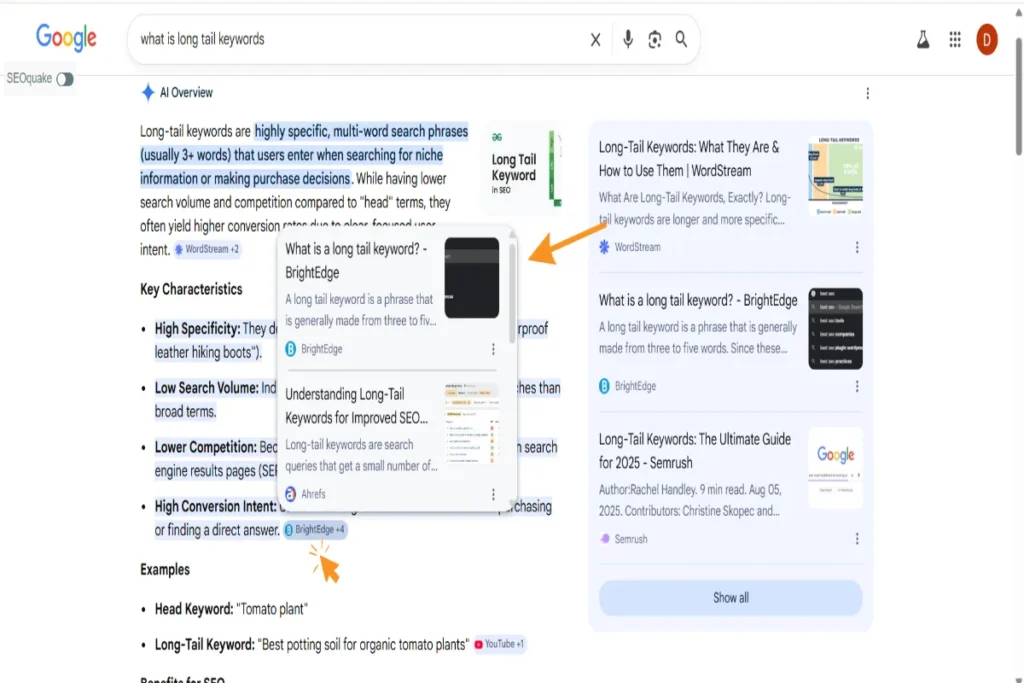
The idea is to reduce friction in the browsing experience, so finding and accessing relevant information feels faster, clearer, and more intuitive. On February 18, 2026, Robby Stein VP of Product for Google Search shared on X that:
In AI Overviews and AI Mode, groups of links will automatically appear in a pop-up as you hover over them on desktop, so you can jump right into a website to learn more.
In simple terms, you no longer have to search around for sources. Just hover, and you’ll instantly see a group of relevant links you can click on to learn more. This small change makes a big difference, it helps users move more quickly from an overview to the actual source.
Along with this, Google is also introducing more descriptive and clearly visible link icons across both desktop and mobile. Early testing suggests that these updates are already improving engagement and making it easier for users to access relevant content.
So while it might seem like a subtle update, it’s clearly aimed at making information discovery faster, smoother, and more intuitive.
Official Launch of AI-Powered Configuration in Google Search Console
Google has officially rolled out its new AI-powered configuration feature in Google Search Console and it’s now available to all users.
Earlier, this feature was limited to a small set of websites, but now anyone using Search Console can access it.
So, what’s new here?
Instead of manually setting up filters, adjusting dates, or figuring out which metrics to select, you can now simply describe what you want to analyze in natural language.
For example, you could just type something like, “How is my traffic compared to last month,” and the system will take care of the rest.
The AI automatically applies the right filters, sets up date comparisons, and selects relevant metrics like clicks, impressions, average CTR, and average position.
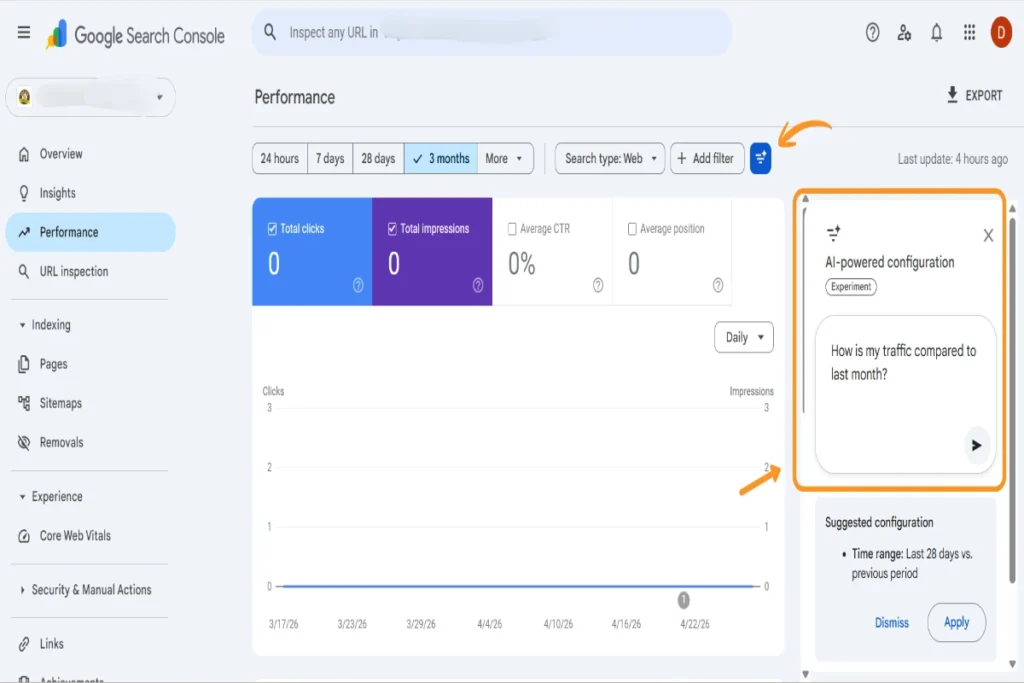
In short, it removes a lot of manual effort and makes reporting much quicker and easier.
It’s a simple upgrade, but one that can save a lot of time when you’re regularly analyzing search performance data.
Google Reduces Rankings for Self-Promotional “Best Of” Listicles
In February 2026, many SaaS and B2B websites started noticing a sharp drop in their Google rankings and organic traffic.
Interestingly, Google didn’t officially confirm any update at that time. Still, the impact was quite clear, especially for websites that were publishing self-promotional “best of” listicle articles where they ranked themselves at #1.
Over the past year, this had become a common practice many companies were creating such listicles on their blogs to rank themselves or their products at the top, sometimes even promoting each other within these lists. Because this tactic was working well in search (and even showing up in AI results), its usage increased rapidly.
To address this, Google appears to have taken action against this pattern, leading to noticeable drops in rankings, especially in blog and guide sections where such content was concentrated.
As highlighted by Lily Ray, VP of SEO Strategy at Amsive, some of these sites saw their organic visibility drop by as much as 29% to 49% within just a few weeks.
Notably, these declines were not site-wide. Google primarily impacted blog and guide sections where such listicles were concentrated, while core product pages remained largely unaffected.
Final Insights
Overall, the February 2026 updates clearly show where Google is heading towards better content quality, improved user experience, stronger security, and more AI-friendly systems. The focus is quite clear now: relevance, authenticity, and real value matter more than ever.
For website owners and marketers, the approach doesn’t need to be complicated just focus on creating genuinely useful content, avoid over-optimization or self-promotional tricks, and gradually align with how AI-driven search is evolving.
Many similar AI and search-related developments were also seen in the following month, which we covered in our article SEO Updates March 2026: 14 Digital Marketing Changes You Need to Know.
What do you think about these updates?
Are these changes already affecting your website? Share your experience in the comments.