What changed in SEO during May 2026? May 2026 brought several updates across search, ads, and the broader marketing landscape – some small, some significant, but all worth knowing about.
If you manage a website, run ads, or work in SEO, these updates are relevant to you. Some will require action on your end, while others are simply useful to be aware of.
In this article, we’ll explore the major changes from May 2026 and uncover what they mean for the way you plan and optimize your SEO efforts.
IAC Shuts Down Ask.com
Long before Google ruled your screen, there was Ask Jeeves – it was one of the most iconic search engines of its time – a place where you could literally type a full question and get an answer, no keywords needed.
After nearly 30 years of serving the internet, Ask.com was officially shut down on May 1, 2026.
Wondering about the name? Ask.com was originally called Ask Jeeves, named after the famous fictional butler. It was rebranded to Ask.com in 2006.
IAC, the company that owned Ask.com, made the tough call to exit the search business for good.
As they stated,
As IAC continues to sharpen its focus, we have made the decision to discontinue our search business, which includes Ask.com.
And just like that, one of the oldest and most legendary search engines in internet history said goodbye to the world wide web.
Here’s the official shutdown message shared by Ask.com.

Google introduces Meridian GeoX
Meridian GeoX is an upcoming global, open-source incrementality solution that lets you run transparent, cost-effective, and publisher-agnostic Geo experiments (GeoX).
These are causal experiments that give you real, evidence-backed answers about what’s truly driving your results. Use them to anchor your marketing strategy and Optimize your Marketing Mix Models (MMM) – so every budget decision you make is grounded in data, not assumptions.
Why It Works for You,
Run More Cost-Effective and Reliable Tests
Instead of running separate experiments for everything, Meridian GeoX lets you test multiple treatments against one common control group – all in a single study. This directly cuts down your costs and saves time. You also get to pick the methodology that best fits your specific business objectives and budget, so you’re only spending what you actually need to.
Trusted Transparency You Can Rely On
Since Meridian GeoX is open-source, you and your team can see exactly how the methodologies work and customize them as needed. You have full control over your experiment designs – holdback, go dark, or heavy up. Documentation, Colab notebooks, and versioning are all there to help your team scale seamlessly.
A Fully Integrated Meridian Solution
Meridian GeoX works directly alongside your Marketing Mix Models (MMM) – giving you more accurate budget allocation across channels. It recommends the best Meridian channels for your experiments and converts your GeoX results into priors that optimize your MMM – making your insights more reliable every time.
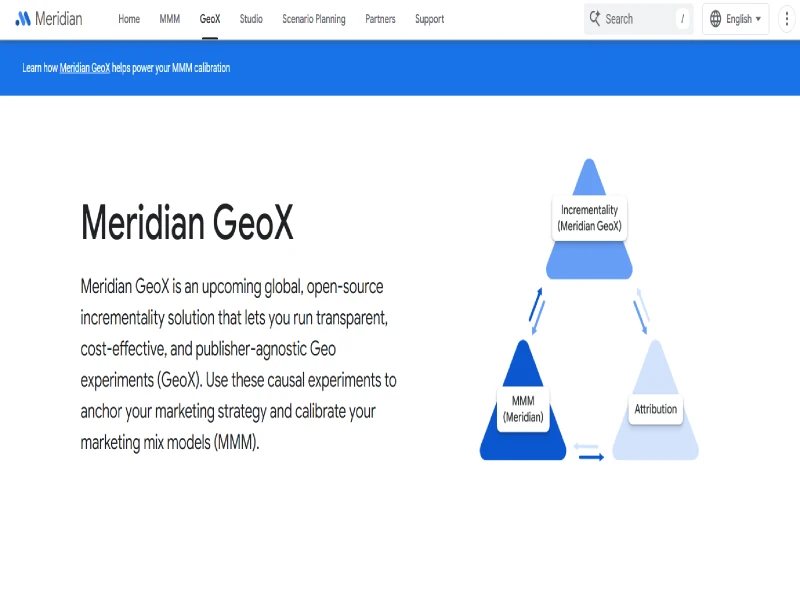
Google says, Meridian GeoX will begin testing later this year.
Google Launched Web Bot Auth:
Google has launched Web Bot Auth, an experimental protocol that changes how bots prove their identity on the web. It is a small but significant step toward making automated traffic more transparent and trustworthy for everyone.
To understand why this matters, you first need to know what a bot actually is.
A bot is any automated program that visits websites without a human controlling it. Search engines use them to crawl and index your content, companies use them to monitor their sites, and AI agents use them to gather information from across the web.
The problem is, until now, there was no real way to verify which bot was actually sending you traffic. Websites had to depend on bots self-reporting their identity through something called a User-Agent header – essentially just a bot saying “hi, I’m Googlebot.” Anyone could fake that, and you had no way to confirm if it was actually true.
So what is different now?
Now, Web Bot Auth lets bots cryptographically sign their requests – basically means using a secret mathematical key to sign something. Think of it like a seal that only you can create but anyone can verify is real.
You can finally verify who is actually sending you traffic, not just who claims to be. Bad actors find it much harder to impersonate trusted bots. You get clearer visibility into how bots interact with your content.
Google Web Bot Auth, an experimental way to validate authentic bots https://t.co/AQ59uqRgEw pic.twitter.com/JIPNzwCyMt
— Barry Schwartz (@rustybrick) May 5, 2026
It is worth noting that Web Bot Auth is still in its experimental stage. It is an active draft specification being developed by the IETF Web Bot Auth Working Group, which means it is subject to change. Not all Google agents are using it yet, and not every request is being signed.
So Google itself advises users in its official documentation:
We recommend that in addition to Web Bot Auth you continue relying on IP addresses, reverse DNS, and user-agent strings as we gradually roll out signed traffic.
OpenAI expands ChatGPT ads with self-serve buying and improved measurement
OpenAI has rolled out some new updates to its ChatGPT ads pilot, and if you run a business, this one’s for you.
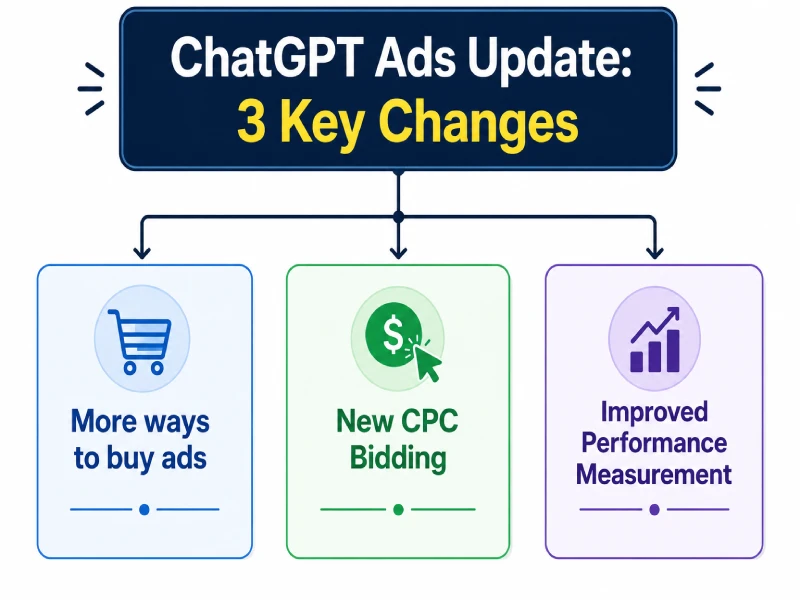
With these new updates, OpenAI is making it easier for businesses to run and optimize ads on ChatGPT. Here are the major changes introduced in the ads pilot:
More ways to buy ads
OpenAI started its ChatGPT ads pilot by working with just a small group of businesses. But now, they’re making it much easier and introducing more ways for businesses like yours to get in.
If you’re looking to run ads on ChatGPT, you now have two options.
The first option? access through partners,
If you already work with agency partners like Dentsu, Omnicom, Publicis, or WPP, or technology platforms like Adobe, Criteo, Kargo, Pacvue, or StackAdapt, you can buy ChatGPT ads directly through them – using the same tools and processes you already rely on.
The second option? through Open AI beta self-serve Ads Manager
OpenAI has launched a beta self-serve Ads Manager – and this one’s for everyone.
Whether you’re running a startup, a small business, or a large brand, you can now sign up yourself, set your budget, upload your ads, and manage your campaigns all in one place.
OpenAI is gradually opening up the Ads Manager to more businesses – and if you’re ready to get started, here are the steps you need to follow to set up your first campaign.
New payment option – CPC Bidding
OpenAI started their ChatGPT ads pilot with just CPM (cost-per-mille) , which means advertisers paid per 1,000 impressions – basically paying just to be seen.
So what’s new? Now there’s cost-per-click (CPC), meaning you only pay when someone actually clicks your ad.
This makes more sense on ChatGPT because people there are often actively comparing options or making decisions – so a click actually means something – it tells you your ad was relevant and actually helped someone make a decision.
Both CPM and CPC will continue to be supported, so whether it’s CPM or CPC – you choose based on what your goals are. And more bidding options are on the way.
Pay for reach. Or pay for action. The choice is now yours.
Better tools to measure results
If you’ve been running ads on ChatGPT ads pilot, you’ve probably been wondering – “how do I actually know if my ads are working?” And that’s a completely fair ask.
So, OpenAI has now launched Conversions API and pixel tracking, which means you can finally see what happens after someone engages with your ad – whether they made a purchase, signed up, or filled out a form.
And don’t worry about privacy – Advertisers are not getting access to anyone’s personal conversations. They only receive aggregated data that shows them how their campaign is performing overall.
Google changes how links appear in AI Mode/AI Overviews
As AI continues to shape the way you search online, Google is actively working to upgrade your Search experience – particularly features like AI Mode and AI Overviews. The goal is simple: to help you connect with credible sources and find the information that actually matters to you.
So where exactly is Google making these changes? Here are five updates Google has brought to your Search experience.
Explore New Angles
Most topics go deeper than one AI response can cover- and now Google is helping you explore that.
Once you receive an AI response, you will now see suggestions at the end that point you toward where you can go next – whether that is a unique article, an in-depth analysis, or a different perspective on the same topic, making it easier for you to explore.
For example, if you are researching how cities are incorporating more green spaces, you might see a link to a case study on stream restoration in Seoul, or a report on how architects designed New York’s High Line park – giving you a richer, more complete picture of the topic.
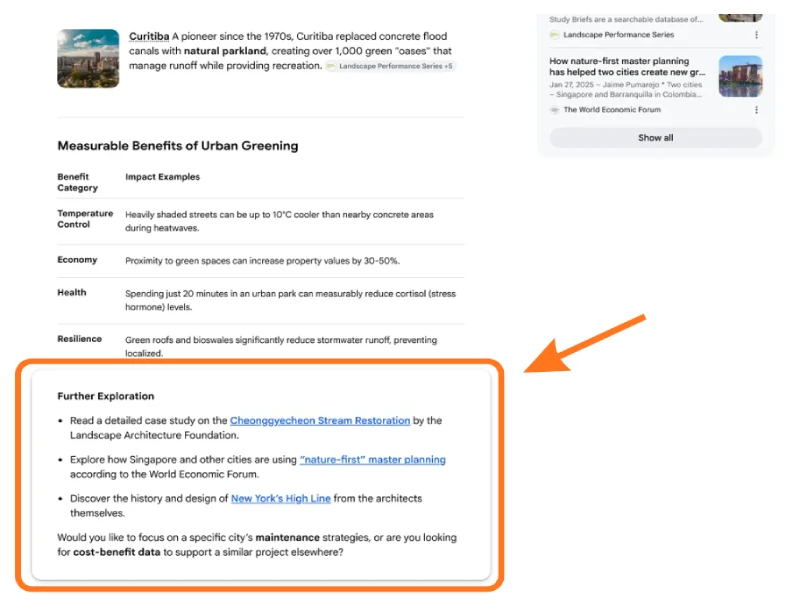
Easily access your news subscriptions.
Trusted news is now just one click away – thanks to a new Google feature.
Google’s new feature highlights links from users’ subscriptions directly in AI Mode and AI Overviews, so you can quickly get to the content you already trust and actually make the most of their subscriptions.
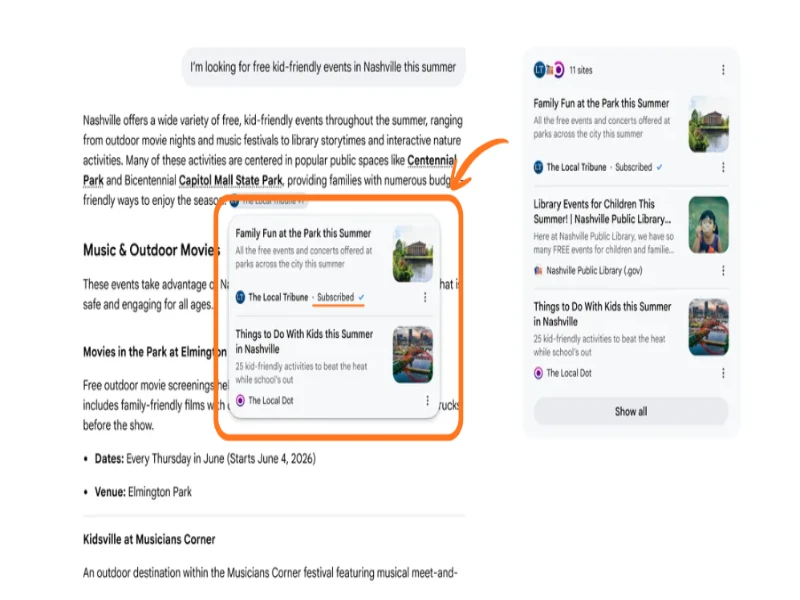
What’s interesting is that early testing showed people were much more likely to click on links when they could see they were from their own subscriptions.
Get advice from people who have been there
When you’re searching for something, sometimes you just want advice from real people. Now, Google’s AI responses will show you previews from public discussions, social media, and firsthand sources – so you can quickly find perspectives that actually help.
You’ll also see extra context like a creator’s name, handle, or community name, making it easier to decide which conversations you want to explore.

See links right where you need them.
Want to explore a topic further while reading an AI response? Now you’ll see more links placed right next to the relevant text – making it easy to dive deeper without having to search all over again.
For example, while reading about a California bike trip, you might see a link to a Pacific coast touring guide next to the terrain bullet point, or a training blog next to the daily mileage one.
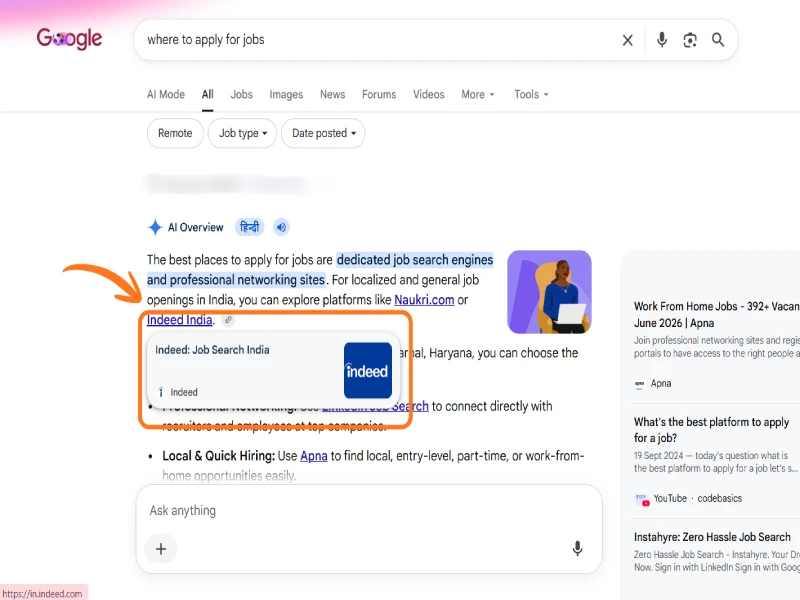
Get more context on linked websites
Users can now see where a link leads – before they even click it.
Now, when you hover over an inline link in Google’s AI experiences on desktop, you’ll see a quick preview of the website – like its name or page title – so you know exactly what you’re clicking into.
Google removing vignette ads triggered by back-button action in AdSense
If you’ve enabled “Allow additional triggers for vignette ads,” here’s something you should know. Starting June 15, 2026, your vignette ads – those full-screen ads users see while navigating between pages – will no longer trigger when a user hits the back button – and this update will apply to your account automatically.
Why is this changing?
Google has rolled out a new policy against back button hijacking – where a site gets in the way of a user trying to navigate back to the previous page.
If you’ve been following Google’s April 2026 SEO updates, this one shouldn’t come as a surprise. To keep your site compliant, Google is removing the back button from the list of vignette ad triggers.
Google AdSense removes browser back button trigger for vignette ads https://t.co/u3kQVBMmKb
— Barry Schwartz (@rustybrick) May 7, 2026
Note: You don’t need to do anything. Google is automatically removing the back button trigger on their end – your other vignette ad triggers will continue to work as usual. your other vignette ad triggers will continue to work as usual.
Google removes support for FAQ schema again
Google removed FAQ rich results completely on May 7, 2026. These were the question-answer dropdowns you used to see in Google search results.
This actually started back in August 2023, when Google restricted them to only government and health websites. So for most sites, they’ve been gone for nearly 3 years already.
Now they’re gone for everyone – no exceptions.
So what do you need to do now? Honestly, nothing. If you have a FAQ schema on your site, don’t stress. Keep it or remove it, it won’t affect your rankings either way. The only thing that’s changed is it won’t show up as a rich result in search anymore.
And if you are using the Search Console API to track FAQ rich result data – you have until August 2026 to adjust your API calls before FAQ rich result support is removed there too.
You may have heard by now that Google is dropping support for all FAQ rich results
— Cyrus SEO (@CyrusShepard) May 9, 2026
So, should you remove all FAQs from your content?
No. No. And probably not.
Google previously stopped showing FAQs for the vast majority of publishers in August 2023, except for a handful of… pic.twitter.com/SptNBJs19W
Google didn’t make any formal announcement about this change. No blog post, no explanation – just a small deprecation notice quietly added to their developer documentation.
Merchant Center for Agencies: Now Rolling Out Globally
After launching in the US and Canada in March, Merchant Center for Agencies is now available globally. If you missed the initial rollout, here’s what we covered in our March update.
Merchant Center for Agencies: Now Rolling Out Globally
— AdsLiaison (@adsliaison) May 11, 2026
Following the launch in the U.S. and Canada, Merchant Center for Agencies is now rolling out to all agencies worldwide.
As product data powers more shopping experiences across Google, agencies now have a more proactive and…
For agencies managing multiple clients, this is your one dedicated space to manage all Merchant Center accounts – from onboarding to optimization to shopping campaigns.
It brings everything under one roof – monitor all client accounts, catch issues before they become bigger problems, and spot optimization and ad growth opportunities across your entire portfolio – all from one place.
New Gemini-powered dashboard in Google Ads
Google Ads has introduced a new Dashboards – an insights tool built with Gemini capabilities that makes your data visualization, analysis, and export a lot more simple and efficient.
With Dashboards, you get an interactive and unified view of all your data in one place – through charts, graphs, tables, and more. No more switching between different sections just to piece together your performance data.

What makes it really useful is that you can simply type a query directly on the dashboard and see real-time updates instantly. Whether you want to check impressions, clicks, video views, cost, or breakdowns by device, audience, or campaign type – just ask, and the dashboard responds right away.
Google I/O 2026 Announcements
On May 19–20, 2026, Google I/O 2026 brought a lot of updates worth knowing about. It brings many announcements including new models, universal search box, and universal shopping cart etc.
Google I/O 2026 introduced – new AI models, personal agents, creative tools, shopping features, and big upgrades to products you already use every day.
Gemini 3.5 Flash is 4x faster than any other AI model, Gemini Spark acts as a personal assistant that handles your emails and tracks subscriptions, and Universal Cart brings all your shopping across Google’s apps into one place. Plus, Search, Maps, and Docs all got some powerful AI-powered improvements too. And there’s a lot more to explore!
Curious about everything else Google announced? Check out the full Google I/O 2026 recap here.
Google May 2026 Core Update Has Finished Rolling Out
Google has officially confirmed that the May 2026 Core Update for Search has completed its rollout. The update began on May 21, 2026, and wrapped up on June 2, 2026.
This is one of their routine updates that they roll out from time to time, and the main goal is quite straightforward – to make sure that when people search for something on Google, they get results that are more relevant and genuinely useful to them.
As Google writes in its linked post confirming the roll out:
This is a regular update designed to better surface relevant, satisfying content for searchers from all types of sites.
If you have been creating helpful, people-first content, you have nothing to worry about – just keep doing what you are doing. That is all Google has ever asked for.
Real-time policy check verification in Google Ads
Google is now making ad approvals way faster with a new system called Real-Time Policy Reviews.
A new system designed to speed up ad approvals by running policy checks in real time, right as you are building your ad.
So what did the old process actually look like? Advertisers would create their ad, submit it, and then simply wait to find out whether it got approved or not — a process that often took a lot of time.
What’s different now? Google has built those policy checks directly into the ad creation process itself – so you instantly know if your ad is ready to run or if something needs to be fixed.
Right now, this feature works only for Responsive Search Ads, and Google plans to expand it to additional campaign types later this year.
Final Insights
May 2026 brought a lot of changes across SEO, search, ads, and AI. Some updates will change how we optimize websites and campaigns.
While every update has a different impact, they all point toward one thing: a smarter, more user-focused future of search.
The main takeaway? Keep focusing on helpful content, better user experience, and staying updated with how platforms are evolving. SEO is constantly changing, but the goal remains the same – creating things that genuinely help people.
Which update did you find the most interesting or impactful? And if we missed any important update, let us know in the comments – we’d love to hear your thoughts.