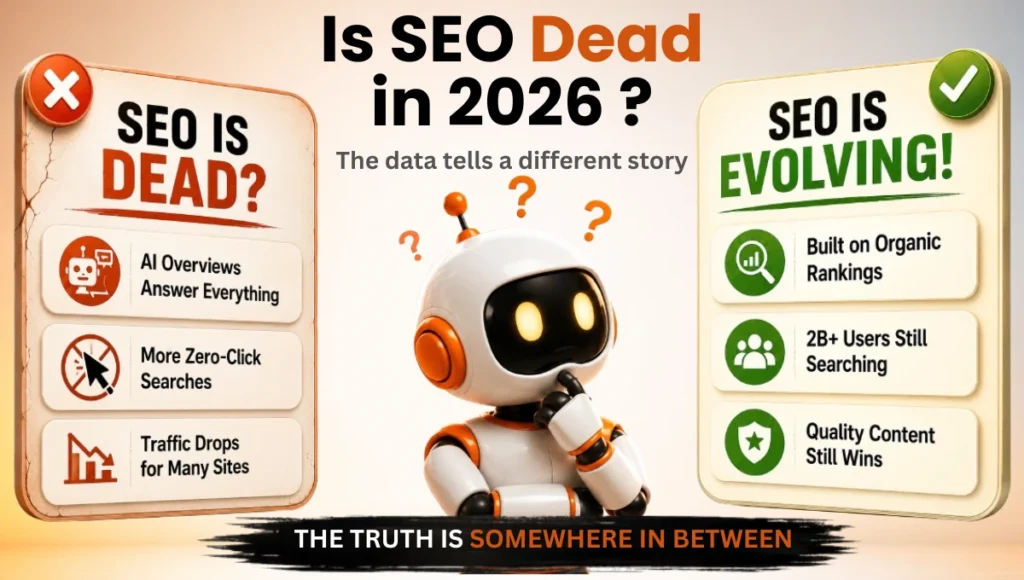
Every few years, SEO gets declared dead. It happened when social media became mainstream. It happened when mobile search took over. It happened when voice search arrived. And it happened again when ChatGPT introduced millions of people to a completely new way of finding information. Now, in 2026, the debate is back.
AI Overviews are answering questions directly in Google Search. AI assistants can generate detailed answers in seconds. Some publishers are reporting traffic declines. And many marketers are starting to ask the same question:
Is SEO still worth investing in?
At first glance, the answer might seem obvious. If AI can answer a user’s question instantly, why would anyone click through to a website?
But before we rush to declare SEO dead once again, it’s worth taking a closer look at what’s actually happening. Because while search is clearly changing, that doesn’t necessarily mean it’s disappearing.
So, Why Is Everyone Saying SEO Is Dead?
The truth is, SEO has been declared dead many times before. But this time, the conversation feels different.
AI-generated answers are appearing directly in search results. Tools like ChatGPT and Gemini have changed how people discover information. Many websites have reported traffic declines, and zero-click searches are becoming more common.
On top of that, SEO itself has become much more competitive. There are more websites, more content, and more platforms competing for users’ attention than ever before.
When you combine all of these changes, it’s easy to see why some people believe SEO is losing its importance. But there’s one problem with that conclusion.
But Is SEO Really Dead?
That’s the question at the center of this debate. Because there’s an important difference between a changing industry and a dying one.
Over the years, SEO has survived multiple shifts that were once expected to make it irrelevant. Social media changed how people discovered content. Mobile devices changed how people searched. Voice search introduced entirely new search behaviors. More recently, AI has transformed how users find and consume information online.
Each of these developments forced SEO to adapt. But adaptation isn’t the same thing as extinction.
So before declaring SEO dead, we need to look beyond assumptions and examine what the evidence actually tells us. Because if SEO is truly becoming irrelevant, the data should make that clear. And if it isn’t, the data should make that clear too.
Most of these arguments focus on how search is changing-not whether search is disappearing. And that’s a very important difference.
What the Data Actually Shows
AI Search Still Runs on Organic Rankings
Here’s something most “SEO is dead” arguments completely skip over: where do you think AI Overviews and AI Mode actually get their answers from?
They don’t appear out of nowhere. Before Google’s AI can summarize anything for you, it has to pull that information from somewhere – and that “somewhere” is Google’s search index, the exact same index that organic rankings come from.
Imagine a chef who’s asked to recommend the best dishes on the menu to a customer. The chef isn’t inventing new dishes on the spot – they’re picking from dishes that are already on the menu, already prepared, already tested. If your dish isn’t on the menu at all, or it’s buried somewhere the chef barely notices, it becomes a lot harder for them to recommend it – no matter how good it actually tastes.
That’s exactly how AI Overviews work. Google’s AI is the chef. Your organic ranking is your spot on the menu. If your page isn’t crawlable, isn’t indexed, or isn’t ranking well for the topic, it has a much harder time getting picked up and cited inside an AI-generated answer – no matter how well-written it is. (And this isn’t just Google – ChatGPT works the same way. OpenAI’s own documentation confirms your site needs to be crawled and indexed before it can ever show up in a ChatGPT search answer, with citations linking back to the original source.)

This suggests that SEO continues to play an important role in determining which sources AI systems can access and cite. The exact same things that have always mattered for SEO – crawlability, content quality, topical relevance, trust signals – are now doing double duty. They’re not just getting you into the traditional blue links anymore. They’re your entry ticket into AI-generated answers, no matter which AI is doing the answering.
SEO didn’t get replaced by AI search. It became the foundation AI search is built on top of.
People Haven’t Stopped Searching
For SEO to die, one thing would need to happen first: people would need to stop searching. But that’s not what the data shows.
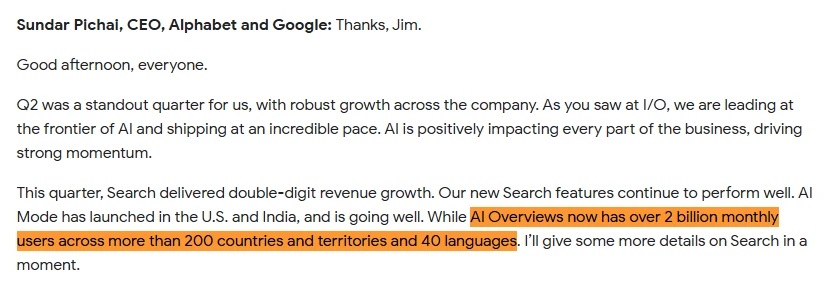
As of mid-2025, Google reported that AI Overviews had reached over 2 billion monthly users across more than 200 countries and territories – and the numbers have only continued to grow since. The company also reported that AI Overviews are driving over 10% more queries globally for the types of searches where they appear.
That’s a strange trend for a technology that’s supposedly replacing search. If anything, it suggests that people are becoming more engaged with search, not less. Google has actually introduced new AI Performance Reports in Search Console so you can see exactly how your site is performing in these AI-powered results.
The way people search is certainly changing. Instead of typing a short query and moving on, users are increasingly asking longer questions, adding context, and following up with additional prompts to explore a topic in greater depth.

Think about your own behavior. You ask a question, get an answer, and then ask another question. You compare options, explore alternatives, and dig deeper into details that matter to you.
Search is becoming more conversational, but it hasn’t become less important. People still research products before making a purchase. They still compare services, read reviews, look for recommendations, and seek trustworthy information before making decisions.
The interface may be evolving, but the underlying need remains the same. People still want answers. And as long as people continue looking for information, businesses will continue competing for visibility. That’s exactly why SEO still matters.
The way people search may be changing, but the need to be found hasn’t gone away.
Google Still Rewards the Fundamentals of SEO
If SEO were truly dead, we’d expect Google to stop caring about the things SEO has always been built around. But that’s not what Google’s own guidance shows.
Today, Google’s ranking systems are designed to surface content that is helpful, reliable, and created for people rather than search engines. The company continues to emphasize expertise, originality, trustworthiness, and a strong user experience as important signals for visibility.

In other words, the goalposts haven’t disappeared. They’ve moved.
A decade ago, some websites could rank by relying on shortcuts, aggressive keyword targeting, or low-quality link building. Those tactics have become far less effective as Google’s systems have evolved.
But the core principles of good SEO remain remarkably familiar. Google still wants content that answers real questions. It still wants pages that demonstrate expertise. It still wants information that users can trust.
If two websites cover the same topic, but one offers original insights, real experience, and useful information while the other simply rewords what already exists online – which one would you expect Google to recommend? That’s the challenge modern SEO is trying to solve.
The tactics may have changed, but the objective hasn’t. SEO today is less about manipulating rankings and more about earning visibility by being genuinely useful.
And according to Google’s own guidance, that’s exactly the kind of content its systems are designed to reward.
AI Search May Send Fewer Clicks – But Better Ones
To be fair, critics of SEO aren’t wrong about everything. For many websites, AI Overviews have reduced the number of clicks coming from search results.
Multiple studies have reported declines in click-through rates when AI-generated answers appear at the top of the page. So if you’re seeing less traffic from certain informational queries, you’re not imagining it.
But fewer clicks and less value are not the same thing.
Think about the type of person who clicks on a website after already seeing an AI-generated summary.
They’ve already received a quick answer to their question. If they’re still choosing to visit your website, it’s usually because they want something more – deeper information, expert insights, pricing details, product comparisons, or a solution tailored to their specific situation.
In other words, they’re making a deliberate decision to click.
Google’s Search Advocate, John Mueller, has publicly stated that clicks from search experiences featuring AI Overviews tend to be higher quality, with users often spending more time engaging with the content they visit.

That doesn’t mean every website will automatically see better results.But it does challenge the assumption that fewer clicks automatically make SEO less valuable. For years, marketers focused heavily on traffic volume. Today, the conversation is increasingly shifting toward traffic quality.
After all, what’s more valuable: 1,000 visitors who leave after a few seconds, or 500 visitors who are genuinely interested in what you offer?
AI-powered search is forcing businesses to think more carefully about that question.
The goal is no longer just getting a click. It’s earning the click from the right person. And helping the right people find the right information has always been at the heart of SEO.
So, Is SEO Dead in 2026?
Let’s go back to the question we started with.
Based on what the evidence actually shows, SEO isn’t dead. But it’s also not the same as it was a few years ago.
Search itself hasn’t disappeared. AI Overviews and tools like ChatGPT still rely on crawled, indexed content to generate answers. People are still searching, in many cases more than before. Google’s own guidelines still reward expertise, originality, and trustworthy content. None of that points to a channel that’s shutting down.
At the same time, some real shifts are happening. Clicks have declined for many websites when AI-generated answers appear. Certain tactics that used to work – keyword stuffing, low-quality content built purely for rankings – are far less effective now, and in some cases don’t work at all.
So the picture is mixed, not one-sided.
What seems to be changing is how visibility is earned. What hasn’t changed is that it still needs to be earned. People still look for information before making decisions. Businesses still need to be found and if you want to track that visibility in GA4, we’ve got a beginner’s guide for that too. That basic need hasn’t gone away – it’s just being met differently than it used to be.
Whether that counts as SEO “surviving” or “transforming into something new” might depend on how you define SEO in the first place. But based on the evidence, the idea that it’s simply dead doesn’t hold up.
Has your own experience with search changed in the past year?
I’d love to hear from you – whether you’re seeing traffic shifts on your own site, noticing how you personally search differently now, or just figuring out what AI search means for your content strategy. Drop your thoughts in the comments below.